

The short answer
A practical ADHD productivity system has six parts: one place to capture tasks, a short current-project list, next actions small enough to start, a deliberately limited daily view, reminders for time-sensitive work, and a brief review that makes restarting easy. Keep optional work out of today’s plan and judge the system by whether it supports the next useful action—not by perfect consistency.
Important note
Loom is a general life-management and productivity tool. It is not a medical treatment or substitute for professional ADHD care.
Why can traditional productivity systems feel overwhelming for some adults with ADHD?
ADHD affects people differently. The National Institute of Mental Health explains that adults with ADHD may experience difficulty with attention, organization, time management, remembering tasks, and completing large projects. The CDC likewise notes that symptoms and their effects vary between adults and can affect organization and daily life.
A planning system can add friction when it presents every captured item at once, requires extensive sorting, builds an overly detailed schedule, or turns one missed review into a backlog of overdue alerts. Those problems do not diagnose ADHD, and productivity difficulty by itself does not mean someone has ADHD.
What should an ADHD-friendly planning system include?
- One capture point. Externalize demands and ideas before deciding what deserves commitment.
- Fewer active outcomes. Keep the current project or Goal list short enough to scan and explain.
- Concrete next actions. Replace vague tasks with a visible starting action and a finish condition.
- A small daily view. Select only the actions that matter today and leave room for transitions and interruptions.
- Selective reminders. Use alerts for genuinely time-sensitive actions so routine notifications do not bury important ones.
- A low-pressure reset. Review current commitments and choose again without rebuilding every old plan.
How can a large task be converted into smaller next actions?
Start with an observable finish line, then ask what must be true immediately before that finish. Continue moving backward until the next action can be done in one sitting. “Prepare quarterly presentation” might become: find the previous deck, write the three decisions the audience needs to make, collect the current numbers, draft the first three slides, and send a review copy.
CHADD’s workplace guidance includes breaking longer projects into smaller steps and using planners or alarms as possible supports. The right action size is personal: small enough to begin, but not divided into so many pieces that maintaining the list becomes the work.
Example: a simple morning planning loop
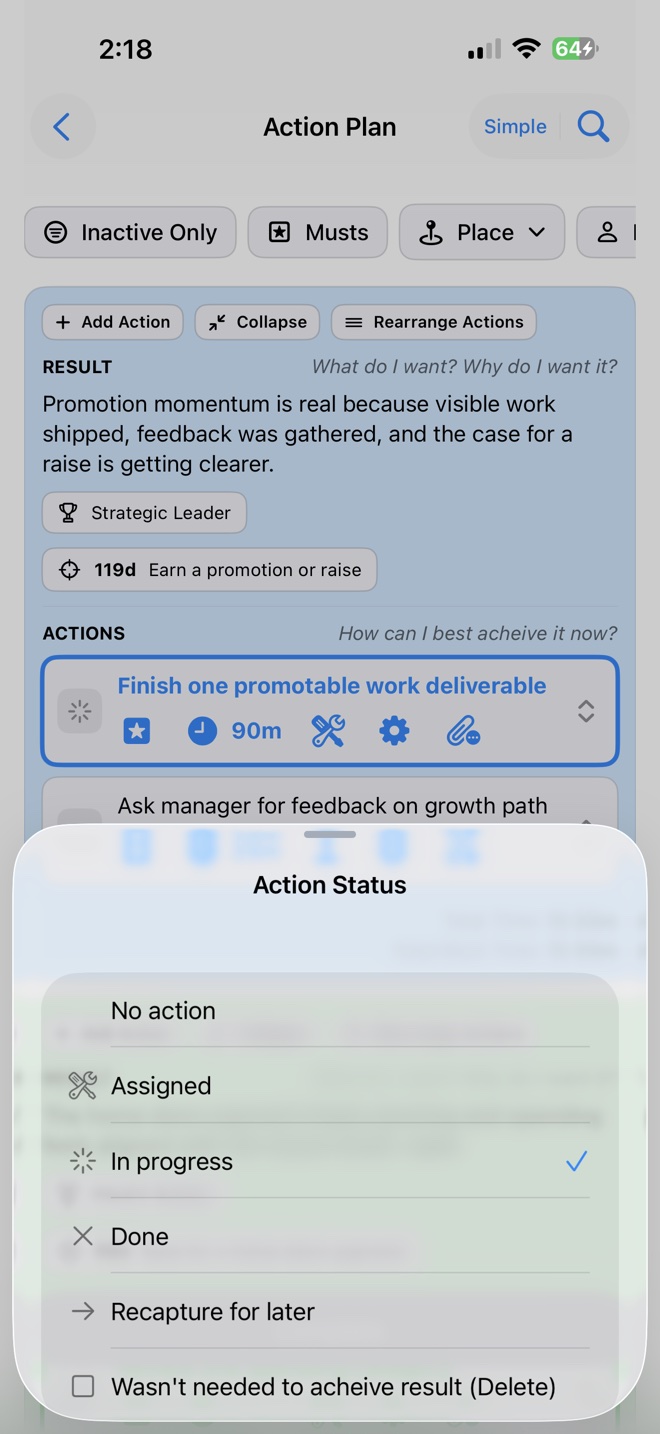
A hypothetical professional starts with one Capture list, reviews three active Goals, and chooses two Musts: draft the client decision summary and call the pharmacy before closing. “Draft the summary” is still too broad, so the first action becomes “open last week’s notes and write the three unresolved decisions.”
Two optional actions stay visible but do not compete with the Musts. At the end of the day, the person records what moved, returns unfinished work to the relevant Goal, and selects tomorrow’s first action.
How can someone restart after abandoning a planner?
Do not begin by cleaning the entire backlog. Make a fresh capture of what is currently demanding attention, check appointments and fixed obligations, identify the few active outcomes that still matter, and choose one next action for each. Archive obviously stale items and leave uncertain ones for a later review. A truthful current plan is more useful than a perfectly migrated history.
Can a productivity app help someone with ADHD?
A productivity app can provide an external place for tasks, priorities, reminders, and reviews. Whether it helps depends on the person, the demands involved, and how much maintenance the tool requires. It cannot diagnose ADHD, provide treatment, decide which commitments are healthy, or replace professional care.
Sources and method
ADHD-related factual context comes from the National Institute of Mental Health, the CDC, and CHADD. The six-part planning loop and examples are original Loom editorial analysis. Loom capabilities were checked against the official App Store listing.