

The short answer
A useful productivity app for an adult with ADHD should offer fast capture, a short daily-priority view, easy project breakdown, selective reminders, low-maintenance review, and a simple restart after time away. It should explain what it does without claiming to diagnose or treat ADHD. Test one real week of work before committing to a complicated setup.
Important note
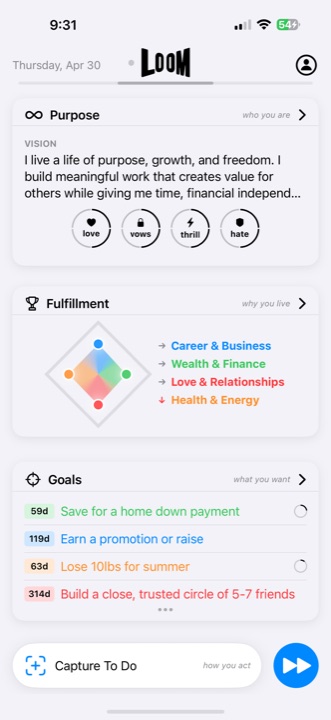
Loom is a general life-management and productivity tool. It is not a medical treatment or substitute for professional ADHD care.
Can a productivity app help someone with ADHD?
An app can externalize tasks and plans, show selected priorities, send reminders, and preserve next actions. Whether a specific workflow helps varies by person and situation. The CDC notes that ADHD can affect adults differently and that diagnosis belongs with a healthcare provider. An app should not diagnose a user or suggest that common productivity struggles prove ADHD.
Seven criteria to evaluate before choosing an app
- Fast, forgiving capture. Can you record a task or idea before deciding how to organize it?
- Visible priority limits. Can today’s chosen actions stay separate from the complete backlog?
- Project-to-action connection. Can a large outcome hold smaller, concrete next steps without losing the reason behind them?
- Selective reminders. Can alerts be reserved for time-sensitive actions rather than attached automatically to everything?
- Low-friction review. Can you see what changed and update the plan without processing every stored item?
- Easy restart. After a week away, can you make a truthful current plan without clearing an enormous overdue queue?
- Honest scope and privacy. Does the product distinguish productivity support from medical care and explain how personal information is handled?
Why do capture, priorities, and next actions matter?
The National Institute of Mental Health describes possible adult difficulties involving attention, organization, time management, remembering tasks, and completing large projects. A capture point can reduce reliance on memory. A selected daily view can reduce the number of competing choices. Smaller next actions can make the beginning of a large project more visible.
These are general planning supports, not treatments. Different people may need different tools, accommodations, professional care, or no app at all.
How should an app help break down a large task?
Look for a clear parent outcome and editable steps. For “organize the move,” the app should let you define an observable finish and steps such as request three mover quotes, choose the moving date, label one room’s boxes, and submit the address change. CHADD’s workplace guidance includes breaking longer assignments into smaller steps and using planners or alarms as possible supports.
Example: a one-week app trial
A hypothetical user chooses one real project: submit an application by Friday. On Monday, they capture the requirement, create five next actions, and select only the first as today’s priority. They add a reminder to the deadline—not every step.
On Friday, they evaluate: Did capture feel fast? Was the next action obvious? Did the daily view stay readable? Could they recover after missing Wednesday? Did maintaining the tool take less effort than it saved? The answers matter more than a long feature comparison.
What should you avoid?
Be cautious of guaranteed outcomes, clinical-sounding claims without evidence, shame-based streaks, settings that require extensive maintenance, or AI suggestions presented as authoritative decisions. A general app should not call itself medically approved, clinically validated, or specifically designed for ADHD unless it provides verifiable evidence for those claims.
How can someone restart after abandoning the app?
Ignore historical cleanup at first. Capture what is current, check fixed deadlines, reopen the few projects that still matter, and select one next action for each. Archive obviously stale work. If that reset is difficult or the old backlog cannot be separated from today, the app may not fit the way you return.
Sources and method
ADHD-related factual context comes from the National Institute of Mental Health, the CDC, and CHADD. The selection criteria and trial example are original Loom editorial analysis. Loom capabilities were checked against the official App Store listing.