

The short answer
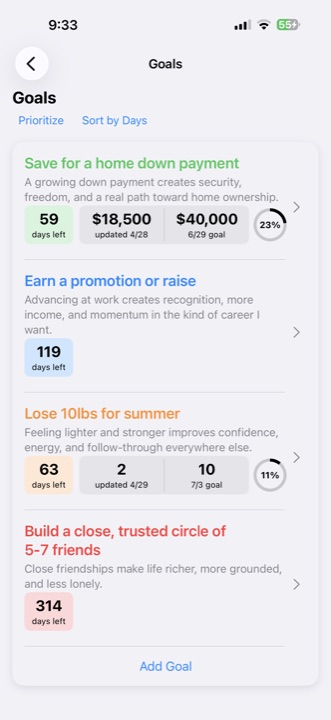
A goal is the result you want. A task is a finite action you complete once. A habit is a behavior you repeat. In Loom, Goals hold desired changes, Action Plans hold finite work, and Little Wins hold repeatable actions. They can share the same Fulfillment Area without becoming the same kind of item.
| Type | Question it answers | Completion pattern | Loom equivalent |
|---|---|---|---|
| Goal | What result am I trying to create? | Ends when the outcome is reached. | Goal |
| Task | What finite action moves it forward? | Completed once, rescheduled, delegated, or removed. | Action Plan or action |
| Habit | What useful behavior should repeat? | Repeats on its selected schedule. | Little Win |
Productivity systems become difficult when every intention turns into the same checkbox. “Publish a credible service page,” “draft the offer section,” and “write for 20 minutes on weekdays” may appear together even though one is an outcome, one is finite work, and one is a repeating behavior.
Which comes first: the goal, task, or habit?
Start with the Goal when you know the result you want. Then choose the smallest finite task that creates visible progress and add a habit only when repetition genuinely supports the result. This prevents a large outcome from becoming a vague aspiration and prevents a daily routine from becoming busywork.
A larger result may need multiple milestones. Loom 2.0 can organize that work as a Project with milestone date ranges and a Gantt timeline, while the individual actions remain finite. The Goal still describes the change; the Project shows the path; today’s Must identifies the current priority.
What makes a Goal different?
A Goal describes a future condition you care about creating. It should make the finish line clearer without pretending you already know every action required. A useful Goal is specific enough to guide choices and meaningful enough to remain relevant when the week changes.
In Loom, a Goal connects to a broader Fulfillment Area. “Publish a consulting service page” can support a Career & Business area, while “plan a monthly family day” can support Relationships. The life context helps explain why the outcome deserves attention.
What makes a task different?
A task is finite work: draft the offer section, confirm the meeting, submit the application, or book the venue. One completion is enough. The task can be completed, rescheduled, delegated, or removed without pretending it is the larger outcome.
In Loom, Action Plans and project actions can carry context such as due dates, duration, Must status, people, places, attachments, notes, and status. To see the full mechanics, learn how to turn the Goal into finite Action Plans and today’s Must.
What makes a habit different?
A habit supports progress through repetition. It should be small enough to remain realistic on ordinary days: write for 20 minutes, review the budget on Fridays, stretch after a walk, or call someone you care about.
Unlike finite work, a habit is not meant to disappear after one completion. Loom calls these repeatable actions Little Wins. They stay connected to the Fulfillment Area or Goal they are meant to support. See how to use small repeatable actions for a larger Goal.
Example: publish a credible consulting service page
- Goal: Publish a credible consulting service page by September 30.
- Action Plan task: Draft the offer section.
- Today’s Must: Finish the first usable draft.
- Little Win: Write for 20 minutes on selected weekdays.
- Reflection: Review what moved, what stalled, and which finite action comes next.
The Goal keeps the result visible. The task removes a finite obstacle. The Little Win protects repeatable progress. Reflection helps the next plan respond to what actually happened.
Can a task or habit exist without a goal?
Yes. Groceries, household maintenance, recurring family responsibilities, and many small commitments can be legitimate without serving a formal Goal. The purpose of context is to improve decisions, not to invent a grand outcome for every action.
A habit also does not need a Goal forever. It may simply support an important Fulfillment Area. Use the lightest structure that makes the next decision clearer, then connect the pieces only when the connection is useful.
How do you decide where something belongs?
- Ask whether it has a finish line. If it describes a meaningful change, it may be a Goal.
- Ask whether one completion is enough. If yes, it is probably an Action Plan.
- Ask whether repetition is the point. If yes, it belongs in Little Wins.
- Connect all three to the same life context. That is what turns separate records into a coherent plan.
Where Loom fits—and where it does not
Loom is an AI-assisted life-management app released for iPhone and iPad. It is a strong fit when you want Goals, finite work, repeatable Little Wins, daily priorities, Capture, and Reflection in one system. It is not an Android or web app, shared team-project manager, calendar-only planner, or medical-care tool. Compare Loom’s complete life-management fit.
Product sources and editorial note
Released Loom capabilities and platform details were verified August 11, 2026 against the official U.S. App Store listing for Loom: Life Manager. This article is first-party Loom analysis, written in Loom’s language, and does not reproduce or formally implement a named third-party methodology. Read the editorial and independence policy.