

The short answer
Choose small daily actions by identifying the part of life or Goal they support, reducing the action until it remains possible on a difficult day, and limiting the set to the few behaviors with the highest practical value. Track repetition as feedback, not as a verdict on your character.
Ambitious people often design habits for their best days. The plan assumes energy, time, privacy, equipment, and motivation will all cooperate. When ordinary life interrupts, the behavior disappears and the missed streak becomes another source of pressure.
Small does not mean unimportant
A small action can protect continuity while larger Action Plans handle major progress. Ten minutes of writing will not finish a book by itself, but it keeps the project psychologically available. A brief walk will not solve every health Goal, but it can preserve movement on a day when a full workout is unrealistic.
The value comes from the relationship between the action and the life area it supports. Random tiny tasks create motion. Connected small actions create momentum.
Choose actions that survive real life
- Start with meaning. Identify the Fulfillment Area or Goal the behavior is meant to support.
- Make success observable. “Take a ten-minute walk” is clearer than “be healthier.”
- Reduce the minimum. Choose a version that remains possible on a busy or low-energy day.
- Choose an honest cadence. Daily is not automatically better than selected days.
- Limit the active set. A few high-impact actions are easier to learn from than a screen full of aspirational habits.
Use streaks as information
A streak can make continuity visible, but it should not make one missed day feel like the destruction of all progress. Look for patterns: Is the action too large? Is the chosen time consistently unavailable? Does the action still support the Goal? Should its schedule change?
Consistency is most useful when it teaches you how to design a better environment and a more realistic plan.
Example: strengthen Health & Energy
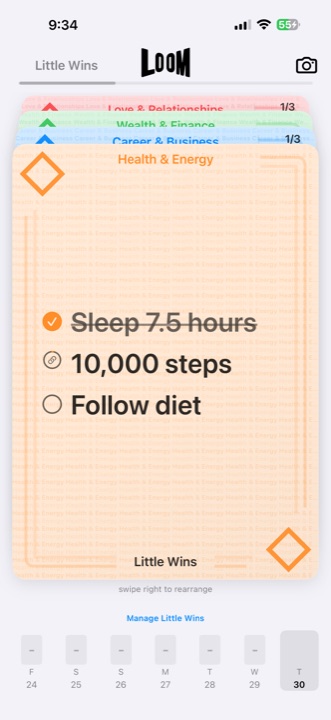
A user may choose three Little Wins: walk for twenty minutes four days a week, prepare tomorrow's water before bed, and complete a short mobility routine on workdays.
The walk can optionally use an approved Apple Health signal when the user grants permission and configures the target. The water preparation and mobility routine can remain manual. Each action is small, observable, and connected to a chosen Fulfillment Area.
How Little Wins work in Loom
Little Wins are Loom's daily progress layer. Users can create repeatable actions inside Fulfillment Areas, select active weekdays or allow completion on any day, record completions, view streak and weekly momentum, and optionally connect supported Apple Health signals.
Loom also supports Little Wins Moments, which turn current progress data into shareable visuals. Sharing is optional; the core value is keeping repeatable progress visible beside Goals and Action Plans.
Do not shrink work that requires a real project
Some outcomes need concentrated time, expertise, or coordination. A tiny daily action can support the Goal but should not replace the Action Plan. Use Little Wins for repeatable support and finite actions for work that must actually be completed.
How this article was developed
This article uses Loom's current product as its source of truth and is independently written in Loom's language. Broader productivity and personal-development materials informed the founder's understanding of the problem, but Loom does not reproduce or formally implement a named third-party methodology. Read the editorial and independence policy.