

The short answer
Set goals across your life by defining a small set of meaningful areas, noticing which areas need active change, and creating Goals only where a finish line would improve decisions. Maintain the other areas with small repeatable actions rather than forcing every part of life into a major project.
People often plan the area that is making the most noise. A difficult quarter at work can consume the space previously reserved for health, relationships, money, learning, faith, or home. The work may be genuinely important; the risk is allowing urgency to make the rest of life invisible.
Start with areas, not a giant goal list
An area of life is something you expect to keep caring for. It is not completed once. Health & Energy, Love & Relationships, Career & Business, Wealth & Finance, learning, faith, service, and home are examples—not a required template.
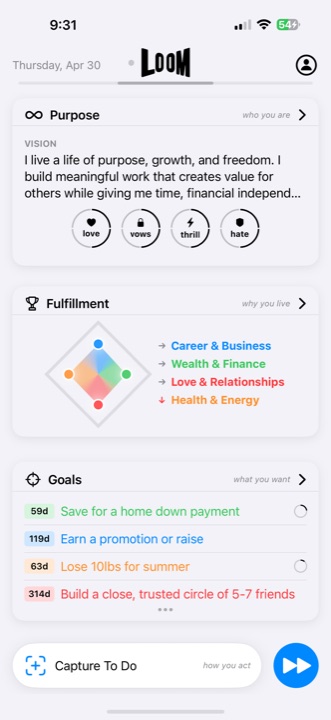
Loom asks users to choose 3–7 Fulfillment Areas and supports custom areas. The constraint is intentional: enough breadth to see your life, but not so many categories that the structure becomes another maintenance burden.
Do not confuse visibility with equal balance
Different seasons require different emphasis. A new child, a product launch, an illness, a move, or a family responsibility can reasonably dominate time for a period. Whole-life planning does not demand equal hours. It helps you make the tradeoff consciously and protect a minimum level of care where neglect would create larger problems.
Choose which areas need a Goal
A Goal is useful when an area needs a defined change: complete physical therapy, rebuild a relationship ritual, earn a certification, eliminate a debt, or create a consistent creative practice. An area that is already stable may need only a Little Win or periodic review.
- Name 3–7 areas that matter now. Use language that feels natural to you and include custom areas where needed.
- Describe what “strong” means. Write one sentence about how life looks when each area is being cared for.
- Notice the largest useful gap. Which area would materially improve life if it became stronger during this season?
- Create a Goal only where a finish line helps. Keep maintenance areas lighter.
- Add Action Plans and Little Wins. Use finite work for projects and repeatable actions for continuing support.
A season does not need seven major goals
A founder may choose Career & Business, Health & Energy, Love & Relationships, Wealth & Finance, and Mind & Meaning as current Fulfillment Areas.
The active Goal might be to launch a new paid product. Health may be protected with three Little Wins: a walk, a consistent bedtime, and two workouts. Relationships may use a planned weekly dinner. Wealth may need one Action Plan to update a cash forecast. Mind & Meaning may need only a weekly reflection.
The system shows the whole life without pretending every area deserves a major project at the same time.
How Loom supports flexible life areas
Fulfillment Areas are editable and user-defined. They can hold a Mission, Identity, focus, Little Wins, resources, and connected Goals. Loom uses them to keep daily activity associated with the part of life it is meant to strengthen rather than treating categories as decorative folders.
Avoid turning the framework into self-judgment
Fulfillment Areas are decision aids, not a scorecard for your worth. A difficult season may reduce visible progress. The useful question is not whether every area looks perfect; it is whether your current choices reflect the responsibilities and values you actually intend to protect.
College can make this whole-life tradeoff unusually visible: courses, work, career preparation, health, money, and relationships can all matter in the same week. The college student productivity app fit guide shows one realistic way to connect those layers.
How this article was developed
This article uses Loom's current product as its source of truth and is independently written in Loom's language. Broader productivity and personal-development materials informed the founder's understanding of the problem, but Loom does not reproduce or formally implement a named third-party methodology. Read the editorial and independence policy.