

The short answer
A weekly life review should help you recognize progress, clear or update stale commitments, check whether important life areas received attention, and choose a small set of next priorities. It is not a performance trial or an excuse to rebuild the entire system every week.
Plans decay quietly. A task is postponed but remains marked urgent. A Goal changes without its supporting actions changing. A repeatable behavior no longer fits the schedule. Completed work disappears so quickly that the week feels unproductive even when important progress occurred.
Review creates a deliberate moment to reconcile the plan with reality.
Begin with what actually happened
Before looking for failures, acknowledge completed Action Plans, Little Wins, conversations, decisions, and moments that mattered. Progress is evidence. It tells you what conditions helped, which actions were appropriately sized, and which life areas received real attention.
Clear stale commitments
Look at unfinished actions and make a decision. Complete them, schedule them, delegate them, return them to Capture, or remove them. Carrying an item forward should be an active choice rather than the default consequence of avoiding it.
Reconnect with the larger context
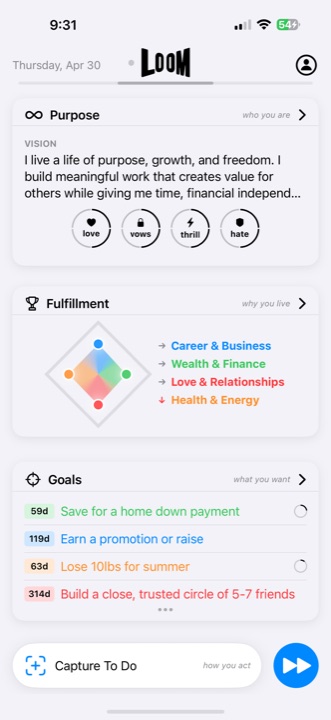
Review current Goals and Fulfillment Areas. Ask whether the week's activity still supports what matters, whether one area has been neglected, and whether a Goal remains relevant in the current season.
This is not a demand for perfect balance. It is a check against unintentional neglect.
- Acknowledge progress. Record completed work, Little Wins, useful decisions, and meaningful moments.
- Process what is still open. Decide what each Capture item and unfinished action now means.
- Review active Goals. Confirm that the desired outcome and timeline remain useful.
- Notice life-area gaps. Identify where a small action could prevent avoidable neglect.
- Choose next Musts and Little Wins. Protect a small set of finite priorities and repeatable support actions.
A 25-minute review
Spend five minutes acknowledging completed work and Little Wins. Spend ten minutes deciding what to do with unfinished Action Plans and Capture items. Spend five minutes checking active Goals and Fulfillment Areas. Use the final five minutes to choose the next Musts and adjust Little Win schedules.
A longer review may be useful during a major transition, but duration is not the point. The review succeeds when the plan becomes more truthful and the next choices become easier.
How Reflection supports the loop in Loom
Loom keeps Reflection beside the system it evaluates. Completed actions, outcomes, and current structures can inform what worked, what fell behind, and what should change. The archive preserves evidence that would otherwise disappear from the active plan.
Because Goals, Action Plans, Little Wins, Capture, and Fulfillment Areas are connected, the review does not require rebuilding context across several unrelated apps.
Keep review from becoming rumination
If review consistently produces self-criticism without a clear decision, shorten it. Focus on observable facts, changed constraints, and one useful adjustment. A review should make the next week lighter and more accurate—not ask you to relive every unfinished intention.
How this article was developed
This article uses Loom's current product as its source of truth and is independently written in Loom's language. Broader productivity and personal-development materials informed the founder's understanding of the problem, but Loom does not reproduce or formally implement a named third-party methodology. Read the editorial and independence policy.