

The short answer
To-do lists become overwhelming when they collect faster than they help you decide. Every item appears to deserve attention, unfinished commitments stay visible indefinitely, and important work competes with small errands on the same flat surface.
The problem is rarely that you need to capture fewer things. Work, family, health, money, relationships, and ideas all create legitimate demands. The problem is asking one list to serve as an inbox, a priority system, a goal plan, a habit tracker, and a record of everything you might do someday.
A list stores tasks. It does not supply meaning.
A task such as “call Alex” can be urgent, meaningful, optional, or obsolete. The words alone do not tell you whether the call repairs an important relationship, advances a current goal, or merely felt relevant two weeks ago. Without context, your brain has to re-evaluate the entire list every time you open it.
That repeated decision-making is one reason long lists feel heavier than the work itself. The list has preserved the obligation but discarded the reason, desired result, and current priority.
Four patterns make the pressure worse
- Capture without clarification: new items enter the list, but no later decision determines what they mean.
- Everything looks equally important: a two-minute errand sits beside the action that protects a major goal.
- Goals stay hidden: the list shows motion without showing what the motion is meant to change.
- Nothing leaves gracefully: stale, delegated, repeated, and someday items remain mixed with current commitments.
Use a connected system instead of a bigger list
The goal is not to build a complicated productivity ritual. It is to give each type of commitment an appropriate home and make the next useful decision easier.
- Capture first. Put the item somewhere reliable without pretending you have already committed to it.
- Name the desired change. Ask what would be different if this mattered and was completed.
- Connect it to context. Identify the Goal or Fulfillment Area it supports. If it supports neither, it may be an errand, an optional item, or something to remove.
- Choose the Must. Mark the action whose absence would make the plan fail, rather than labeling several items as equally urgent.
- Review what remains. Complete, reschedule, delegate, return to Capture, or remove stale work before it becomes background pressure.
A practical example
Imagine a list containing “update résumé,” “schedule a physical,” “research retirement account,” “text a friend,” and “prepare Monday presentation.” A flat list offers five unrelated demands.
With context, the presentation becomes a Career & Business Must for this week. The physical belongs to Health & Energy and receives a date. The retirement research supports a Wealth & Finance Goal. Reaching out to the friend can become a small repeatable Little Win for Love & Relationships. The résumé may return to Capture until a current career Goal makes it relevant.
What Loom changes
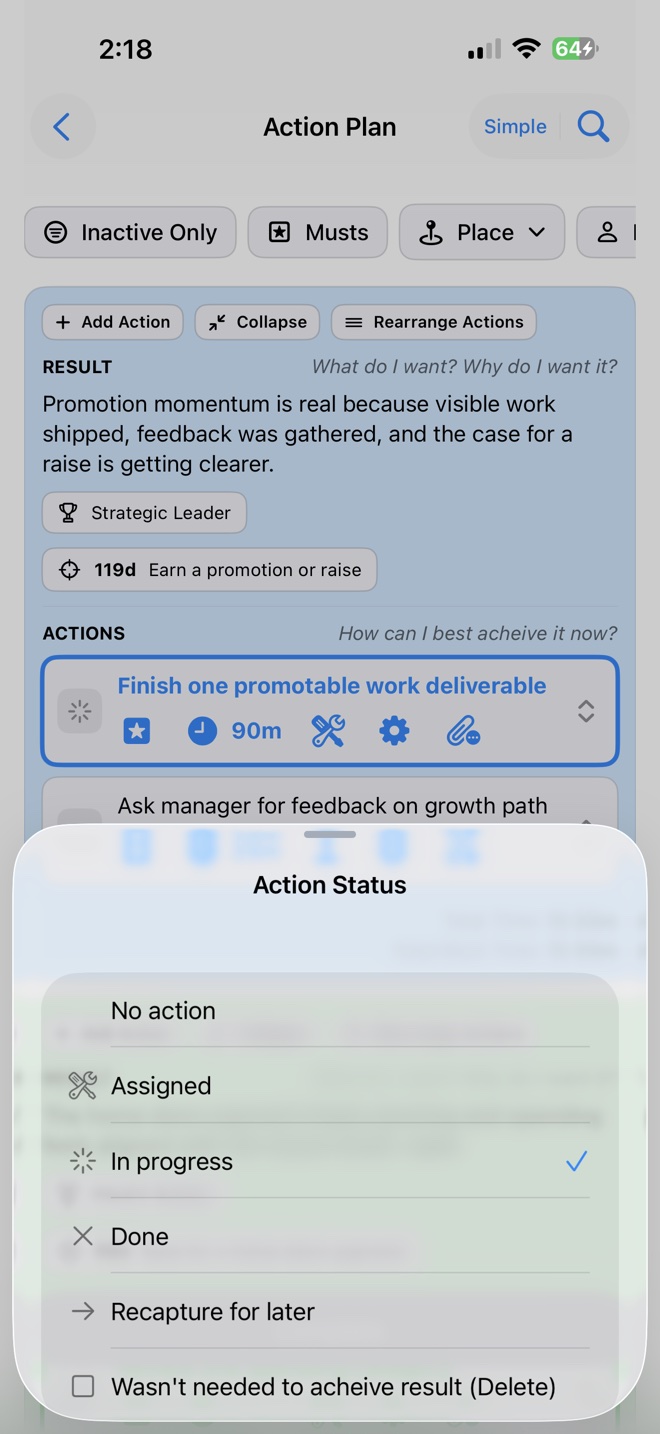
Loom keeps fast Capture, but it does not treat Capture as the finished system. Items can move into Action Plans with dates, duration, status, Musts, people, places, links, files, and notes. Goals and Fulfillment Areas supply the reason and broader context. Little Wins hold repeatable actions that should not clutter a finite task list.
The result is not a magically empty day. It is a clearer distinction between what arrived, what matters, what repeats, and what you have actually chosen to do.
When a simple list is enough
If you have a short set of errands, one small project, or temporary work that does not need goal or habit context, a basic list may be faster. Loom is most useful when your responsibilities span several life areas and the cost of choosing the wrong work is higher than the cost of recording it.
How this article was developed
This article uses Loom's current product as its source of truth and is independently written in Loom's language. Broader productivity and personal-development materials informed the founder's understanding of the problem, but Loom does not reproduce or formally implement a named third-party methodology. Read the editorial and independence policy.