

The short answer
When you feel overwhelmed, organize your life in five layers: capture every demand, group responsibilities by life area, choose a few current outcomes, turn those outcomes into next actions, and select only the actions that deserve attention now. Put appointments on the calendar, but keep goals, commitments, repeatable habits, and reflection in a system that preserves why each action matters.
Work and personal priorities collide because they compete for the same limited time and attention. A work list, family calendar, notes app, habit tracker, and journal may each hold useful information, but none can show the complete tradeoff when they remain disconnected.
What should you organize first when everything feels urgent?
Start with capture, not prioritization. Write down the deadline, conversation, errand, concern, idea, and personal commitment currently competing for attention. Capturing is not agreeing to do everything. It creates one inventory so your decisions are based on the real workload rather than whichever demand is loudest.
Keep this inbox temporary. A capture list becomes another source of pressure when items stay there without a decision.
Separate responsibilities from projects and next actions
Use three distinct levels:
- Life areas are ongoing responsibilities such as business, health, relationships, home, money, or personal growth.
- Goals and projects describe a change or outcome with a finish line.
- Next actions are finite steps you can actually complete.
“Client launch” is not the same kind of thing as “Health,” and neither is as actionable as “Review the final launch page.” A flat list makes unlike items compete as though they were interchangeable.
A five-step framework for competing priorities
- Capture the whole load. Include work, personal administration, relationships, health, and ideas without sorting as you write.
- Name the life area behind each demand. This reveals when one area is consuming attention and another is becoming invisible.
- Choose the outcomes that matter in this season. Limit active Goals instead of promoting every concern into a project.
- Write the next visible action. Replace vague topics with finite steps that can be started and completed.
- Select today's Musts. Choose the smallest set that protects important outcomes and commitments, then leave capacity for reality.
Example: a launch week with family responsibilities
Imagine a professional preparing a client launch while also arranging a parent’s medical appointment and trying to protect a basic exercise routine. The system might show one Career Goal, one Family Action Plan, and one Health Little Win.
Today’s Musts could be “approve launch copy” and “confirm appointment transportation.” A 15-minute walk remains a repeatable Little Win rather than becoming another project. Lower-value launch polish stays visible but does not compete equally with the two real commitments.
This is not perfect balance. It is a deliberate tradeoff with the rest of life still visible.
Where should calendars, task lists, notes, and habits fit?
Calendars are best for events and protected time. Task lists are useful for finite actions. Notes preserve reference material. Habit trackers show repetition. Journals support reflection. Problems arise when one tool is expected to represent every layer, or when the layers never reconnect.
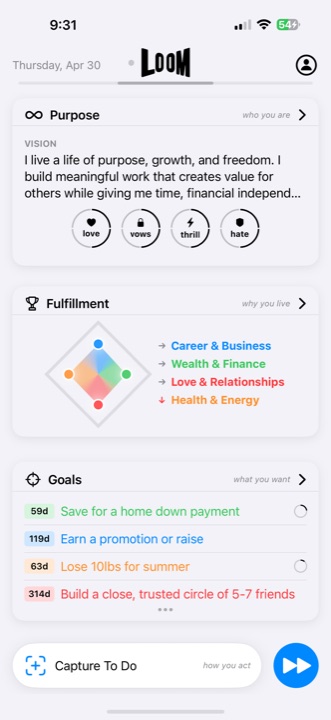
A useful system lets you move from meaning to Goal, from Goal to Action Plan, from plan to daily priority, and from completed work to Reflection. An AI chat may help brainstorm, but it should not silently decide what matters or become the only place where the reasoning lives.
When a simpler system is enough
If you have one short project and a stable personal routine, a calendar and a basic task list may be sufficient. Add structure only when disconnected tools make priorities hard to compare or when completed tasks no longer produce progress on what matters.
Sources and method
This framework is Loom-original editorial analysis. Peer-reviewed research on action planning and goal pursuit provides general context for converting intentions into plans; it does not validate this specific framework. Current Loom capabilities were verified against the official App Store listing. See Loom’s editorial and independence policy.