
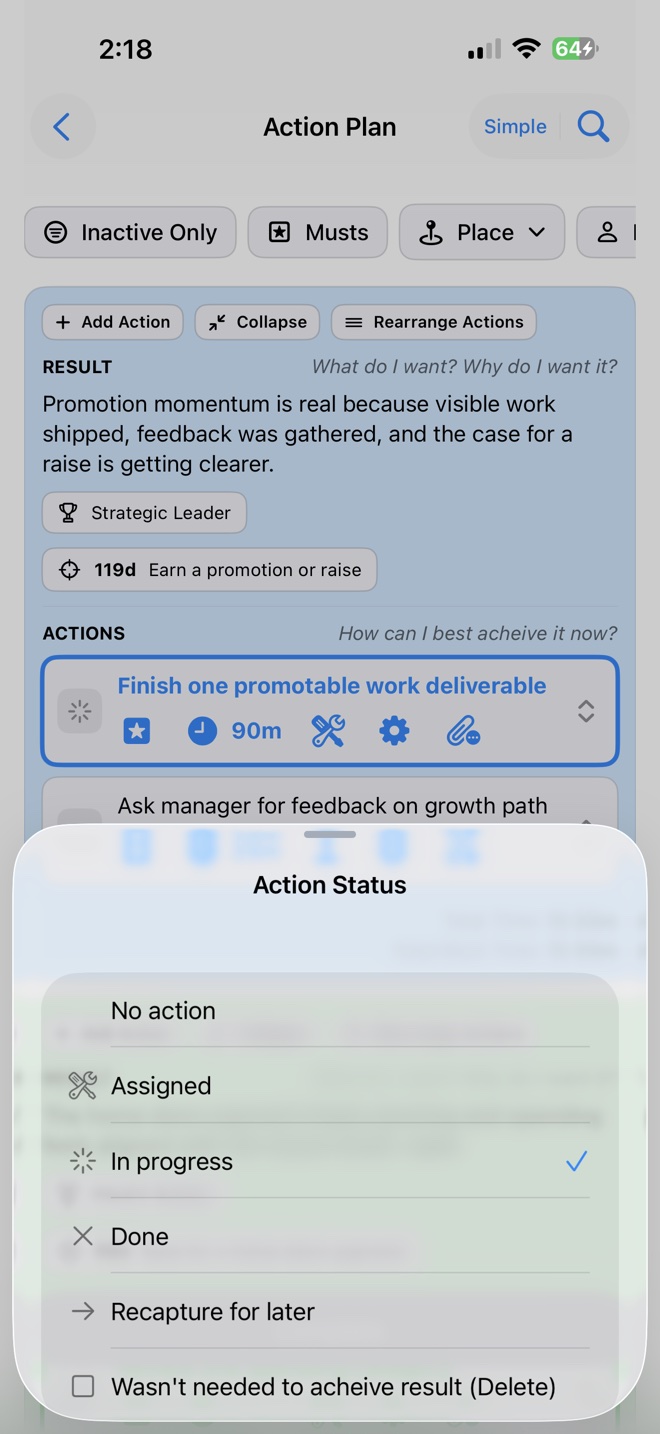
To be more productive, stop measuring the day only by how many items disappeared. Capture incoming work, connect important actions to desired outcomes, choose a small number of Musts, protect repeatable support with Little Wins, and review whether the work produced useful progress.
Productivity problems often begin before execution
If every incoming request becomes urgent, working faster only increases the speed at which other people and random events choose your day. The first improvement is not a new shortcut. It is a clearer boundary between what arrived and what you have committed to do.
Separate Capture from commitment
Capture protects information from being forgotten. Commitment requires a decision. An item may become an Action Plan, receive a date, connect to a Goal, move to another person, remain in Capture, or disappear.
Use context to choose the Must
A Must is the finite action that most protects the current plan. It may resolve a dependency, prevent a meaningful cost, or create the next evidence of progress. Use the Goal and Fulfillment Area to evaluate it rather than allowing inbox order or emotional noise to decide.
Move repetition out of the task list
Exercise, writing, prayer, learning, connection, and planning can be important without becoming permanently overdue tasks. Little Wins give repeatable actions a separate daily layer and an honest cadence.
Protect focused action with realistic context
Add duration when you need to know whether the action fits. Add a person or place when coordination or environment matters. Attach the document that would otherwise create a search. Specific context reduces the friction between deciding and beginning.
Example: a productive Monday
Monday begins with twelve Capture items. Three are informational and remain in Capture. Two are delegated. Four become dated Action Plans. One becomes the Must because it unblocks a current Goal. A repeated follow-up becomes a Little Win on selected weekdays. Two items are removed.
The day did not become productive by doing twelve things. It became productive by making twelve honest decisions and protecting the work with the highest current value.
Review output and alignment
At the end of the week, acknowledge completed actions and useful moments. Look at what remained unfinished, whether the Musts were appropriately chosen, and whether important Fulfillment Areas were unintentionally neglected. Change the system rather than merely promising to try harder.
Productivity is not a treatment for exhaustion
Sometimes the useful action is rest, medical care, a difficult boundary, or fewer commitments. Loom can organize decisions and optional Health signals, but it does not diagnose or treat stress, burnout, or health conditions.